18 October 2026
Sell Sambalpuri & Odisha handloom online with your own store
A practical guide for weavers, cooperatives and boutiques to sell Sambalpuri, Bomkai, Berhampuri Patta and other Odisha handloom through their own online store, with photos, payments, shipping and WhatsApp updates.
6 min read
Yes — an Odisha weaver, cooperative or boutique can sell Sambalpuri, Bomkai, Berhampuri Patta and other handloom directly to buyers across India with their own online store, taking UPI and card payments and shipping by courier. The store works best when each product page tells the weave's story clearly and WhatsApp handles order updates, so customers trust a small seller they have never met.
Odisha handloom has a strong reputation far beyond the state. Several Odisha textiles are registered geographical indications, including Kotpad handloom fabric, Orissa Ikat, Khandua, Gopalpur Tussar, Sambalpuri Bandha, Bomkai, Habaspuri and Berhampur Patta (Phoda Kumbha) saree and joda (list via OdishaBytes). Buyers in Bengaluru, Pune or Dubai actively search for these names. The question is whether they find you, or a reseller.
Marketplace vs your own store
| Big marketplaces | Your own store | |
|---|---|---|
| Traffic | Built-in, but shared with many sellers | You bring it (Instagram, Google, WhatsApp) |
| Pricing pressure | High — similar-looking sarees side by side | Lower — buyers come for your work |
| Story and brand | Limited template | Full weaver, village and GI story |
| Customer contact | Restricted | Yours, for repeat sales |
| Fees | Commission and fees per order | Payment gateway fee per order |
| Starts from | Free to list | ₹50,000 (~$530) one-time |
You do not have to choose one forever. Many sellers keep a marketplace listing for discovery and push their best and repeat buyers to their own store, where margins are better.
What a handloom store needs
Product pages that answer every question
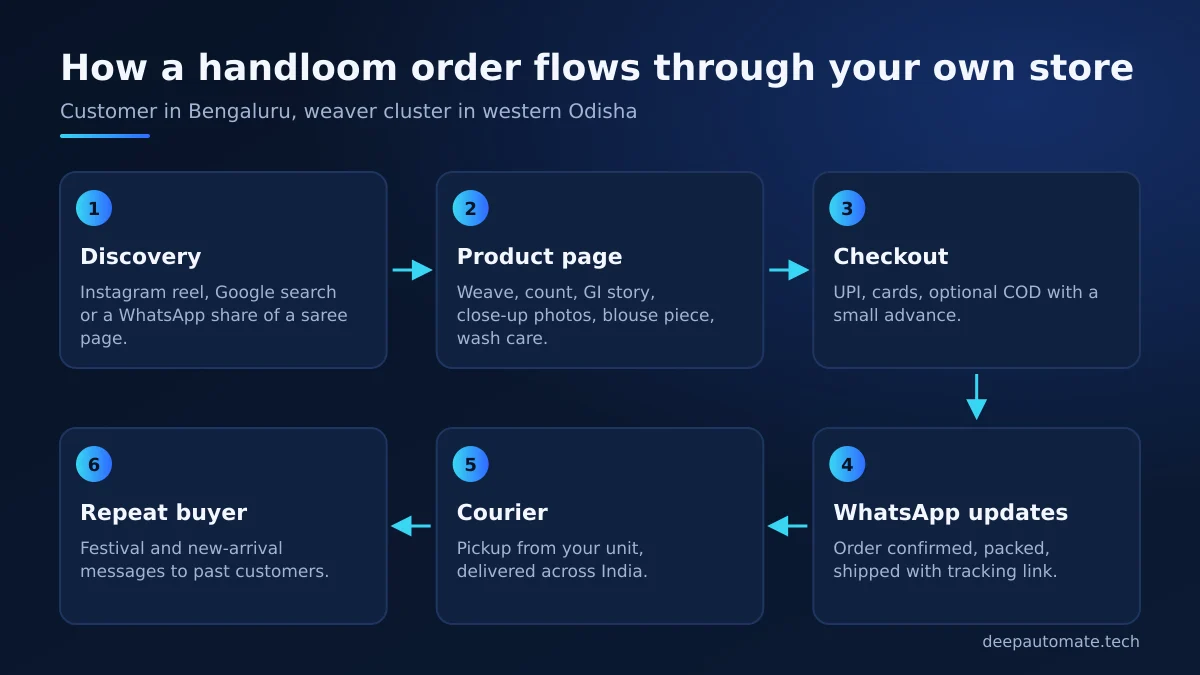
A saree buyer online cannot touch the fabric, so the page has to do that job. For every product include:
- Weave and technique — single ikat, double ikat, Bandha, Bomkai border, Pasapali, Kumbha temple border.
- Fabric — cotton, mulberry silk, tussar; thread count if you know it.
- Origin — village or cluster (Bargarh, Sonepur, Nuapatna, Berhampur) and, if true, the weaver or family.
- Measurements — length, whether a blouse piece is included.
- Care — dry clean or gentle hand wash, colour bleeding advice.
- Photos — full drape, pallu close-up, border close-up, reverse side and one in daylight. Honest photos reduce returns.
GI and authenticity — handle with care
Do not put "GI tagged" on a product unless it genuinely comes from the registered region and meets the specification. In 2023 the central government began work on enabling authorised-user GI tags for Sambalpuri weavers (OdishaBytes report). If you are part of a cooperative, ask how you can use the GI mark correctly. Honest claims build trust; misleading ones can damage the whole craft.
Payments
Indian buyers expect UPI first, then cards and net banking. A payment gateway handles all of these and sends money to your bank account. For international buyers, ask the gateway about cross-border payments before you promise them.
Shipping
Sarees are light and ship well. Use a shipping aggregator that picks up from your unit and gives tracking links. Fold sarees in tissue, use a waterproof inner bag and a sturdy outer box — monsoon deliveries are not kind to cardboard.
Cash on delivery — decide deliberately
COD brings more orders but also more refused deliveries, and a returned silk saree costs shipping both ways. Many sellers keep prepaid as the default and allow COD only on lower-value items.
WhatsApp: the trust layer
Handloom buyers love to ask questions before paying: "Is the colour exactly like the photo?", "Can I see it in daylight?", "Is there a matching dupatta?". A WhatsApp button on every product page lets them ask, and a WhatsApp Business API setup can then send automatic messages: order confirmed, packed, shipped with tracking, delivered. Past buyers who opt in can get new-arrival messages before Raja, Durga Puja or wedding season.
Pricing sarees online without underselling the weaver
Online buyers compare quickly, but they also pay for authenticity when it is explained. A few practical rules:
- Price the work, not the platform. Start from yarn, dyeing, weaving days and the weaver's wage, then add packaging, shipping and the payment gateway fee. If the number feels high, explain why on the product page — "a double ikat saree like this takes many weeks on the loom" is a reason, not an excuse.
- Show shipping clearly. Either include it in the price or show it before checkout. Surprise charges at the last step are a common reason people abandon carts.
- Offer a range. Cotton stoles and kerchiefs at an accessible price let first-time buyers try you; silk Bandha and Bomkai sarees are for buyers who already trust you.
- Avoid permanent discounts. Festival offers are fine, but a saree that is "70% off" every day makes buyers doubt the original price.
Running costs to plan for
Once the store is live, expect a few recurring costs: domain renewal, hosting, the payment gateway's fee on each successful payment, courier charges, packaging, and a little time each week to photograph and upload new pieces. Ask for these in writing before you start so there are no surprises. If you want a broader view of budgets, see our guide on website development cost in Odisha.
Getting your first buyers
A new store has no traffic on day one. Practical ways to start:
- Share product links, not just photos. Every WhatsApp status and Instagram post should link to the product page.
- Short videos. A 20-second reel of the loom, the tie-and-dye process or the drape gets shared.
- Google. Write unique descriptions — not copy-pasted ones — so pages can rank for searches like "Sambalpuri cotton saree with Pasapali border".
- Repeat buyers. A buyer who loved one saree is your best customer. Keep their contact (with consent) and tell them about new pieces.
- Government platforms. NSIC's MSME Global Mart and the Odisha e-Pavilion on it can complement your store; see our guide to Odisha MSME Global Mart.
See a working demo
We built a demo store called "Odia Handloom Co." so you can feel the shopping experience before you invest: browse sarees and stoles, add to cart and check out. Try the demo store.
Start your handloom store
If you are a weaver, cooperative or boutique in Sambalpur, Bargarh, Sonepur, Berhampur or anywhere in Odisha, see our pricing for e-commerce plans, then message us on WhatsApp at +91 79788 39679 with a few product photos and how you sell today. You can also write to us from the contact page.
Frequently asked questions
Should I sell handloom on marketplaces or on my own website?
Marketplaces bring traffic but you compete on price next to many similar listings and have less control over your customer relationship. Your own store lets you tell the weaver and GI story, keep customer contacts and sell to repeat buyers. Many sellers use both.
Can I mention the GI tag on my product pages?
Several Odisha textiles, including Sambalpuri Bandha Saree & Fabrics and Berhampur Patta, are registered geographical indications. Only describe a product as GI if it genuinely comes from the registered area and meets the GI specification; ask your cooperative or the registered proprietor about authorised use.
How much does a handloom e-commerce website cost?
Our e-commerce websites start from ₹50,000 (~$530) and typically take 4–6 weeks, including product setup, payment gateway and shipping integration.
Should I offer cash on delivery for sarees?
COD can increase orders but also returns, which hurts on high-value sarees. A common middle path is prepaid by default, with COD available on lower-value items or with a small advance paid online.