17 October 2026
How to choose an app development company in Bhubaneswar
A practical checklist for choosing an Android and iOS app development company in Bhubaneswar or anywhere in Odisha: portfolio checks, ownership, scope, payments, store accounts and maintenance.
6 min read
To choose an app development company in Bhubaneswar, install and use apps they have actually shipped, confirm that the source code and store accounts will be in your name, and insist on a written scope with milestone payments against builds you can test on your own phone. Price matters, but ownership, clarity and after-launch support decide whether the app is still working two years from now.
Bhubaneswar has a growing tech scene, and you will find everything from solo freelancers to large IT companies. Odisha businesses also hire teams from Cuttack, Berhampur, Kolkata or Hyderabad. Location matters less than process. This checklist is what we would tell a friend before they sign anything — even if they do not hire us.
First: do you actually need an app?
An app is the right answer when customers or staff will open it again and again: ordering groceries every week, booking classes, tracking deliveries, field staff logging visits. If people will use it once or twice a year, a fast website plus a WhatsApp bot is usually better and much cheaper.
| Need | Better first step | When an app makes sense |
|---|---|---|
| Show services and get enquiries | Website | Rarely |
| Take orders from regular customers | Website + WhatsApp ordering | High repeat usage, loyalty points |
| Bookings and reminders | WhatsApp booking bot | Members, subscriptions, packages |
| Field staff, attendance, photos, GPS | App | Almost always |
| Marketplace with buyers and sellers | Web app first | When usage is proven |
If you are unsure, read our guide on app development cost and compare it with a WhatsApp bot.

The checklist
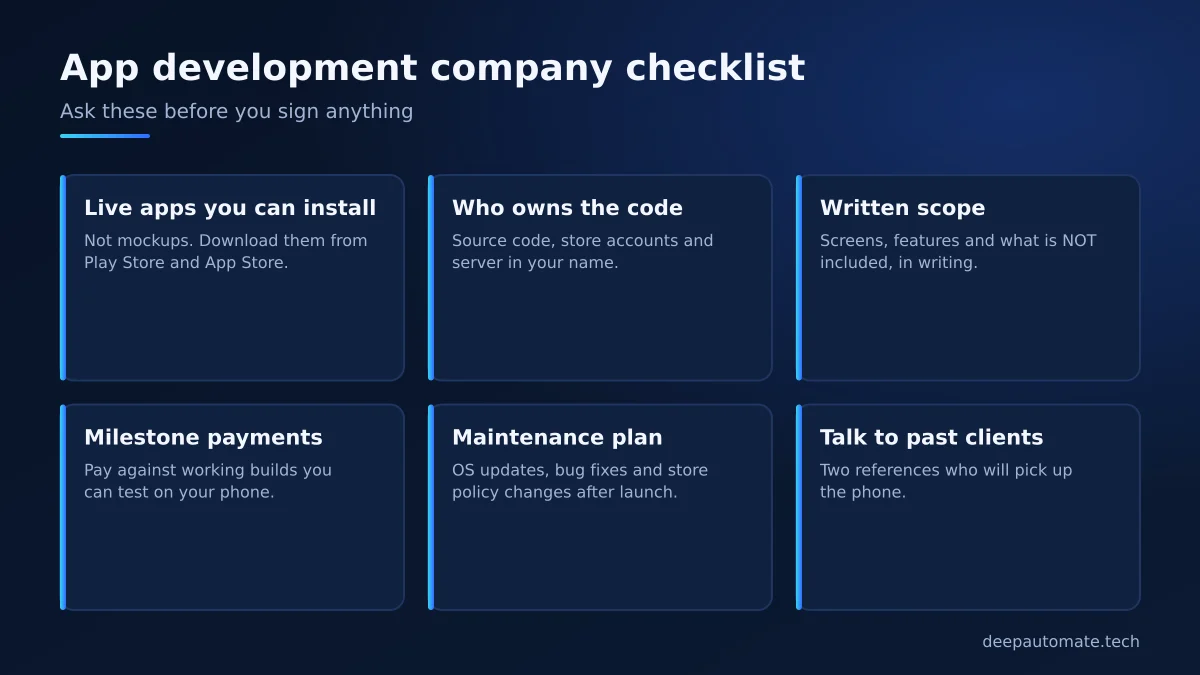
1. Live apps you can install
Screenshots and design mockups are easy to produce. Ask for links to apps on the Google Play Store and Apple App Store that the company built, then install them. Check:
- Does it open quickly on a normal phone?
- Are there recent updates, or was it abandoned?
- Read the reviews — how did the developer respond to problems?
2. Ownership: code, accounts and servers
This is where many Odisha businesses get stuck. Before you sign, get it in writing that:
- Source code is handed over in a repository you own.
- Google Play developer account is in your business name. Google charges a one-time US$25 registration fee (Google Play Console Help).
- Apple Developer account is in your business name (Apple charges an annual membership fee; check the current amount on Apple's developer site).
- Server and database are in an account you control, or can be moved to one.
If an agency says "we will publish under our account to save you trouble", politely decline.
3. A written scope
A one-line quote — "food delivery app, ₹X" — invites trouble. A good scope document lists:
- Every screen, with a one-line purpose.
- User roles (customer, admin, delivery partner, branch manager).
- Integrations (payment gateway, SMS, WhatsApp, maps, Tally).
- What is not included.
- Who provides content, images and test data.
It is fine if the scope evolves, but changes should be written down with their effect on cost and time.
4. Milestone payments against working builds
Pay in stages tied to something you can touch: clickable design, first working build on your phone, feature-complete build, store release. Avoid paying the full amount upfront. A team that is confident in its delivery will be comfortable with this.
5. Cross-platform or native?
For most business apps, cross-platform frameworks (Flutter, React Native) give you Android and iOS from one codebase. Native development makes sense for heavy graphics, complex offline work or deep hardware integration. Ask the company why they recommend one over the other for your case. A clear answer is a good sign.
6. Testing on real phones
Many customers in Odisha use mid-range Android phones, often on patchy mobile data in smaller towns. Ask how the company tests on low-end devices and slow networks. An app that works perfectly on the developer's flagship phone may crawl on your customer's.
7. Maintenance after launch
Android and iOS release major updates every year, and store policies change. Someone has to keep your app compliant and working. Ask:
- What does maintenance include, and what does it cost?
- How do you report a bug, and how is it tracked?
- If you stop working together, how is the handover done?
8. Talk to two past clients
Ask for two references and actually call them. Ask what went wrong and how the company handled it. Every project has problems; what matters is how they were solved.
Questions to ask in the first meeting
Bring this short list to your first call or meeting in Bhubaneswar. The answers tell you more than any presentation:
- "Who exactly will write the code, and can I speak to them?" — you want to know whether the work is done in-house or passed on to someone else.
- "What will I be able to test after the first two or three weeks?" — a confident team names something concrete.
- "What happens if the Play Store or App Store rejects the app?" — rejections are common for first releases; a good team has fixed them before.
- "How do I get my data out if I leave?" — the answer should be simple: database export plus source code.
- "What do you need from me?" — content, logos, test accounts, decisions. Delays on the client side are as common as delays on the developer side.
Write the answers down and compare them across companies. Vague or defensive answers are themselves an answer.
Red flags
- No live apps to show, only designs.
- Refusal to put accounts or code in your name.
- A price that seems too good, with no written scope.
- Pressure to pay everything upfront "to block the team".
- Vague answers about who will actually write the code.
What our app projects look like
Our Android + iOS apps start from ₹1,00,000 (~$1,050), with a typical timeline of 8–12 weeks. Every project includes a written scope, milestone builds you install on your phone, store accounts in your name and full source code handover. See all plans on our pricing page. If your app will capture leads or enquiries, take a look at our AI lead demo to see how incoming requests can be scored and routed automatically.
Talk to us about your app
If you are planning an app in Bhubaneswar, Cuttack or anywhere in Odisha, send us a short description on WhatsApp at +91 79788 39679 or through our contact page. We will tell you honestly whether an app, a website or a WhatsApp bot is the better first step.
Frequently asked questions
How much does it cost to build an app in Bhubaneswar?
It depends on screens, features and backend. At Deep Automate an Android + iOS app starts from ₹1,00,000 (~$1,050) with a typical timeline of 8–12 weeks. Ask any company for an itemised quote so you can compare like with like.
Should the Play Store and App Store accounts be in my name?
Yes. Create the Google Play developer account and Apple Developer account in your business name and add the agency as a user. If the agency owns the accounts, moving the app later is slow and sometimes impossible.
Native or cross-platform — which is better for a small business?
For most business apps (ordering, booking, member portals, field staff apps), a cross-platform framework like Flutter or React Native gives one codebase for Android and iOS at lower cost. Native code makes sense for heavy graphics or deep hardware use.
Do I need a website before an app?
Usually yes. A fast website and a WhatsApp bot solve many problems at lower cost. Build an app when customers will use it repeatedly, such as for ordering, bookings, loyalty or field staff work.
What happens after the app is launched?
Apps need updates when Android and iOS change, when store policies change and when you find bugs. Agree on a maintenance plan and response process in writing before launch.